Have you ever listened to your students read and noticed them stumble, pause, or skip over longer words? Multisyllabic words can feel intimidating. Even for otherwise confident readers.
That’s why it’s so important to give students regular, simple practice with breaking words apart.
You don’t need to carve out a brand-new block of time or add another complicated routine to your day.
With a few quick, low-prep activities, you can help students practice multisyllabic words in a way that doesn’t feel like extra work.
Why This Matters
By second grade, students are starting to read multisyllabic words with prefixes, suffixes, tricky vowel patterns, and way more syllables than they’re comfortable with.
Without strategies to break those words apart, kids often guess, skip them or lean on context clues. Leaning on context clues will only help if they are available in the text.
Consistent practice with multisyllabic words will help them have strategies to use when they get to multisyllabic words in their reading.
Here are a few easy ways to weave it into your week.

Syllable Puzzles
Prepare puzzles of multisyllabic words by breaking them into syllable-sized pieces. Students can practice putting the pieces together to form complete words, then take them apart again to see how each syllable contributes to the whole.
To extend the activity, have students record the words they build in a notebook or on a recording sheet. They can underline the vowel patterns, mark syllable breaks, or even draw a quick sketch to show meaning.
This type of practice works well in small groups, but it also makes a great literacy station. Kids can work independently or with a partner, and the hands-on puzzle format keeps the practice engaging.
Syllable Sorting Centers
Set up a center with index cards or printed word strips that have multisyllabic words. Students can sort them in different ways: by syllable type (like open, closed, vowel team) or just by the number of syllables.
You can even make it a self-checking activity by writing the answer on the back.
Morning or Small Group Warm-Up
Start the day with a quick mystery word on the board or screen. Students can clap the syllables, draw a line between syllable parts, underline vowel patterns, or label the syllable types before reading it aloud.
It only takes a minute or two, but it reinforces the idea that big words are just made up of smaller parts put together.
This consistent, low-stress practice builds decoding confidence without feeling like a formal lesson.
Partner Games
Pair students up with a stack of word cards and turn decoding into a quick challenge.
One student reads the word aloud after breaking it into syllables, and the other defines it (or uses it in a sentence).
Switch roles and keep going. You can even add a timer for friendly competition.

Another fun partner game, is syllable memory. Students lay all the syllable cards face down. On their turn, they flip over two cards and see if the syllables can be combined to make a real word.
If they create a word, they keep the pair and record it on their sheet. If not, they turn the cards back over and let their partner take a turn.
The goal is to pay attention, remember where syllables are, and practice making multisyllabic words.
Anchor Charts and Visuals
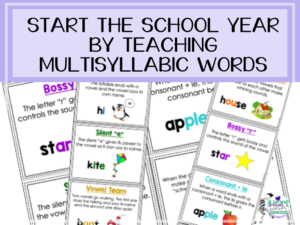
Keep a six syllable types anchor chart posted in a spot that’s easy to see, or create a bookmark students can keep in their independent reading books.
The key is to make those references part of your regular routines.
When a student stumbles on a long word, you can point to the chart and ask, “What type of syllable do you see here?”
Over time, they’ll start using those charts independently, and you’ll see them applying the strategies in their own reading and writing.
Big words don’t have to stop students in their tracks. With a few quick routines like stations, warm-ups, games, and visuals, you can give them the tools to break words apart and tackle reading with more confidence.
And none of it requires a ton of prep.
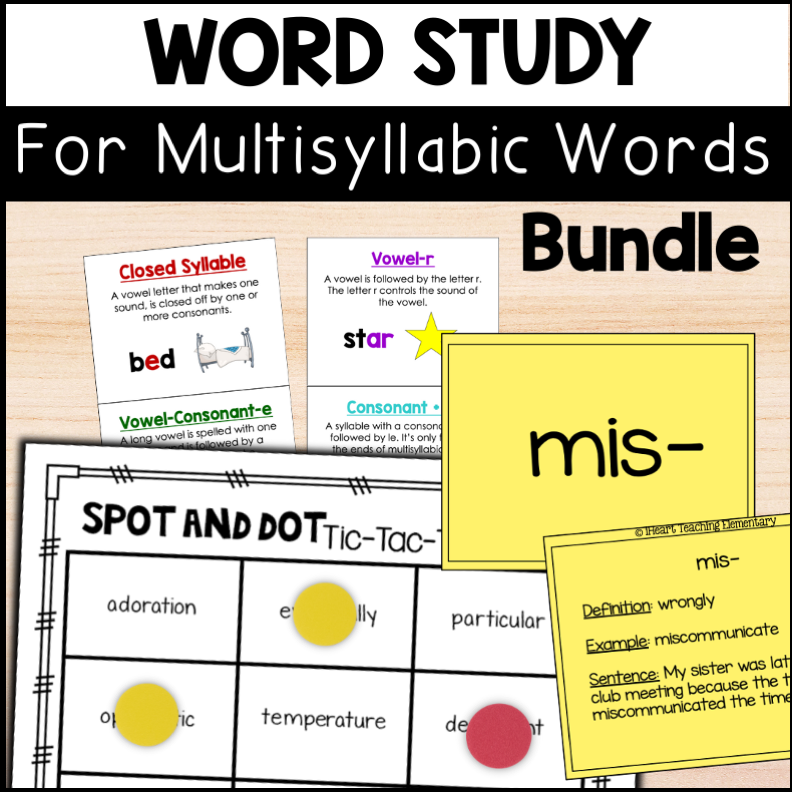
If you’re looking for ready-to-go resources, here are some of my favorites for multisyllabic word practice:


📌 Pin this post to save for later: